
Tourists pay with what they use at home
A foreign tourist pays an inbound agency or DMC quickly when the payment method is the one they already use at home, and stalls at the last step when they are asked for something they do not have.
Picture three bookings on the same night. A couple from Denver pays by card or with the digital wallet they use for purchases abroad. A family from São Paulo has no Argentine bank account, and their bank adds a tax on card purchases abroad, so they prefer Pix from their banking app. A group from Bogotá sometimes does not have their card enabled for foreign payments and books with more confidence through a bank transfer from home.
A tourist from Córdoba, on the other hand, sends a peso transfer. The most common mistake is offering everyone a single method, which is usually the one that suits the agency.
Payment methods for a tour operator, one by one
An inbound tour operator can offer foreign tourists eight payment methods, and each one has a cost that does not show up in the price.
| Method | Arrives in | Clears | Works for | What it really costs |
|---|---|---|---|---|
| Peso bank transfer | Pesos | Instantly | Argentine tourists | Nothing, unless the price is in dollars and the rate moves before they pay |
| Dollar bank transfer | Dollars | Same day from an Argentine account; several days from abroad | Argentines with a dollar account | An international transfer charges fees at the sending bank and sometimes at the receiving one |
| International card | Dollars or pesos, depending on how the charge is set up | Days, depending on the processor | Almost any foreigner | The processor's fee and the chargeback, which can arrive months later |
| International digital wallet | Dollars, in the wallet account | Instantly in the wallet; days to your bank | Tourists from the US and Europe | One fee when you get paid and another when you move the money to your bank |
| Payment link with an Argentine card | Pesos | Sooner or later depending on the term you pick, and sooner costs more | Argentines who want to pay in instalments | Someone pays for the instalments: if they are not in the price, they come out of your margin |
| Pix | The tourist's reais, settled in pesos or dollars | In minutes | Tourists from Brazil | The processor's fee and the rate it fixes when generating the code |
| Local method through a regional processor | Dollars or pesos | Days, depending on the processor | Tourists from Chile, Colombia, Mexico or Peru | The processor's fee and a longer settlement period |
| Cash at boarding | Whatever the tourist brings | On the spot | People who will not pay in advance | That they do not show up: without a deposit, a seat paid in cash is only a promised seat |
None of them works for everyone. What works is offering two or three depending on who is buying, and leaving cash for the balance, never for the deposit.
Local methods: Pix for Brazil and the rest of the region
Local payment methods are the ones a tourist uses at home without going through a card, and they reach an Argentine agency through a processor that charges in the tourist's currency and settles in pesos or dollars.
The best-known case is Pix, Brazil's instant payment system. The agency creates the charge for the booking amount, the processor converts it to reais and builds a QR code that holds that rate for a few minutes. The tourist scans it from their banking app and the payment clears. On the agency's side, what arrives is an amount in the product's currency, not reais that then need to be sold.
For the rest of the region there are regional processors that accept each country's local method, such as bank transfers in Colombia or Mexico, and settle with the agency in dollars. They take longer than Pix to pay out and charge their fee, but they bring in tourists who would otherwise not pay in advance.
Two things are worth checking before choosing a processor. The first is which currency it settles in: if your tours are priced in dollars and you get paid in pesos, you are back to the exchange rate problem. The second is how long the money takes to become available, because a deposit for a Saturday departure is no use if it lands 2 days later.
Dollars or pesos: each product in its own currency
The safest way not to lose on the exchange rate is to charge each product in the currency you pay its supplier in, without converting everything at a single rate of the day.
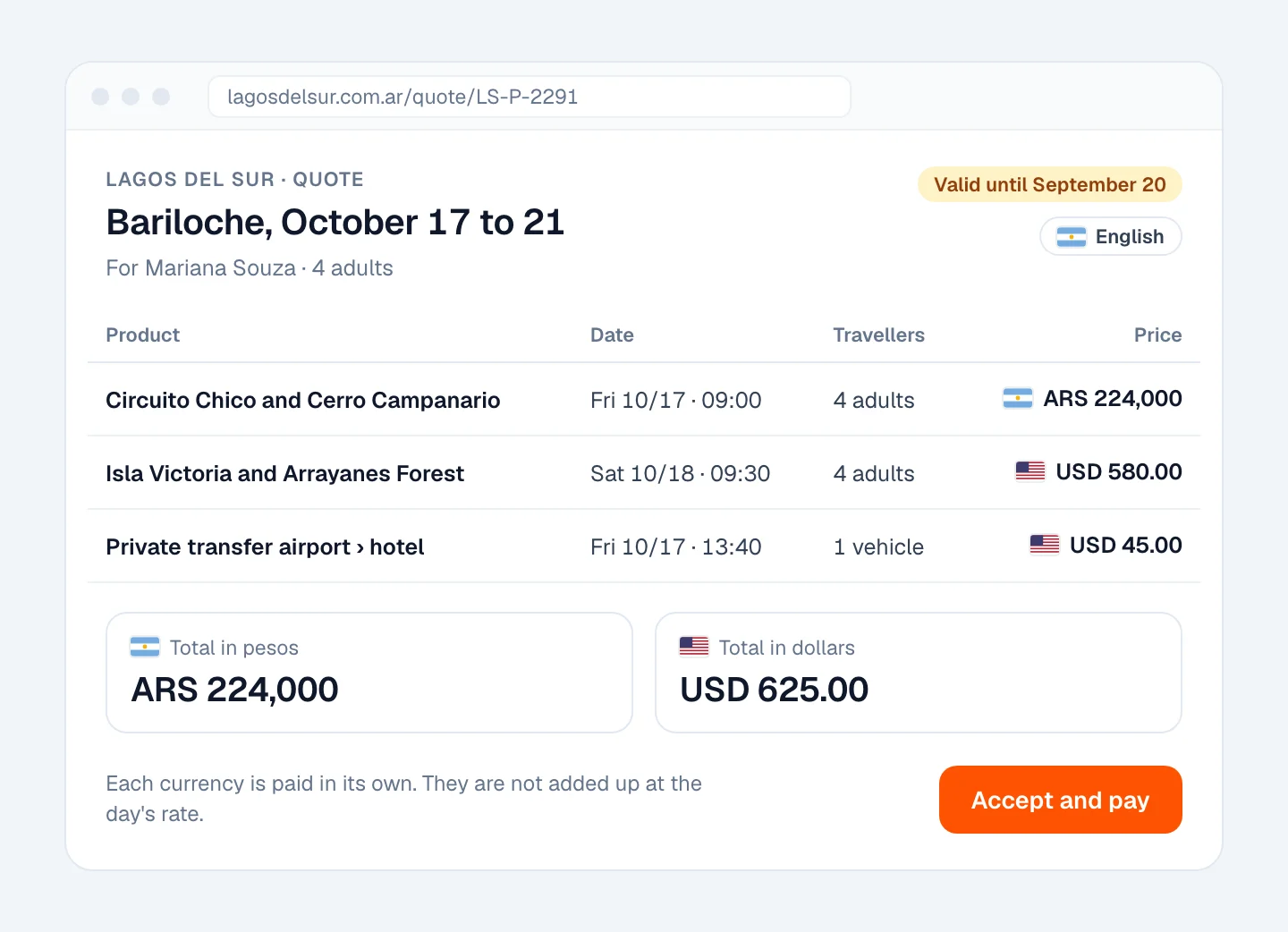
If the boat company settles the Isla Victoria trip with you in dollars, sell it in dollars: USD 145 per person. If you run Circuito Chico with your own van and guide, who are paid in pesos, sell it in pesos: ARS 56,000 per person. For a family of 4, the quote has two totals, ARS 224,000 and USD 580, and that is fine: the tourist pays each one in its currency and the agency does not have to guess what the dollar will be worth on the day it pays the supplier.
The shortcut of adding everything up in pesos at the day's rate looks tidier. The trouble starts when the tourist accepts on Monday, pays on Thursday and the rate moves in between. The tourist is never the one who loses that difference.
Every exchange rate needs an expiry
When the tourist pays in a currency other than the product's, somebody fixes an exchange rate, and that rate needs an expiry date so the risk does not end up with the agency.
With Pix and with cards someone else fixes it: the processor in the first case, the tourist's bank in the second. The problem is when you fix it yourself. If you give an Argentine tourist a peso price for a tour you sell in dollars, tell them how long that number holds. 24 hours is reasonable. 7 days, with the Argentine exchange rate, is giving away your margin.
The same goes for the whole quote. Without an expiry, a peso quote accepted 21 days later gets paid at prices from 21 days ago.
The deposit decides who loses if the tourist cancels
The deposit is the payment that turns a promised seat into a sold one, and the terms for refunding it have to be written down and accepted before you take it.
With foreign tourists it matters more, because once they cancel from another country there is no practical way to claim anything. A rule that works: a 30% deposit for regular tours and the full amount for private departures, which cannot be resold if the group falls through. A seat held without a deposit takes up capacity another tourist could have paid for.
When a refund is due, it goes back through the same method and in the same currency. Refunding in pesos what came in as dollars, or in cash what came in through Pix, opens an argument about the exchange rate that does not end well.
Cards carry an extra risk, the chargeback: the tourist can dispute the payment with their bank weeks or months later. The best defence is keeping what they accepted on file, with the voucher, the date, the cancellation terms and the payment receipt.
How an agency takes payments with Viajalo
In Viajalo each catalogue product has its own currency, and the tourist pays from the agency's website, in their language, with whichever method suits them.
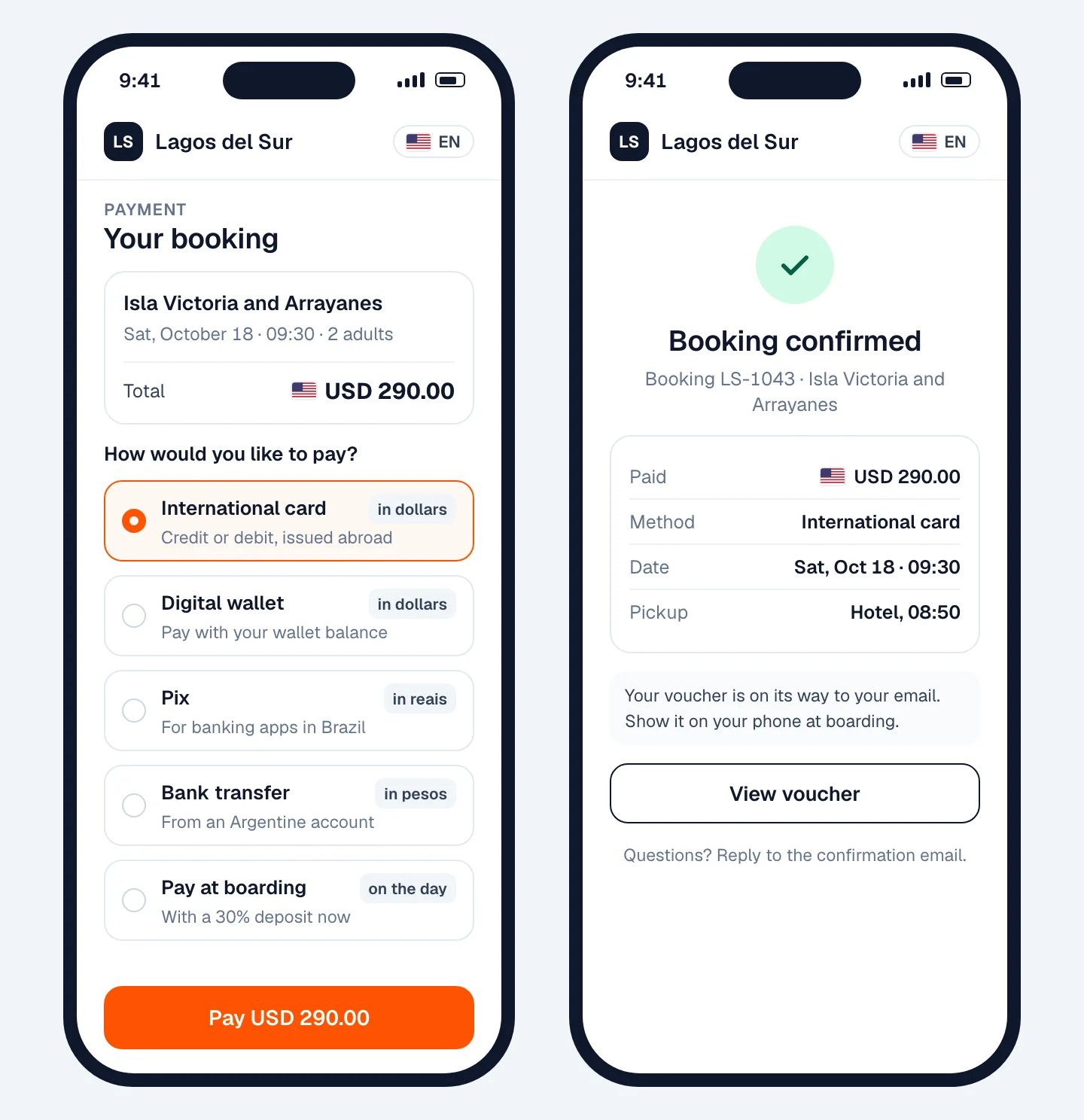
The payment page offers international cards, digital wallets, bank transfer, payment links, Pix for Brazilians and pay-at-boarding with a deposit, and the agency chooses which ones to show. Because the site comes in more than 15 languages, the family from São Paulo sees the checkout in Portuguese and the couple from Denver sees it in English. When the payment arrives, the booking confirms itself and the voucher goes out by email.
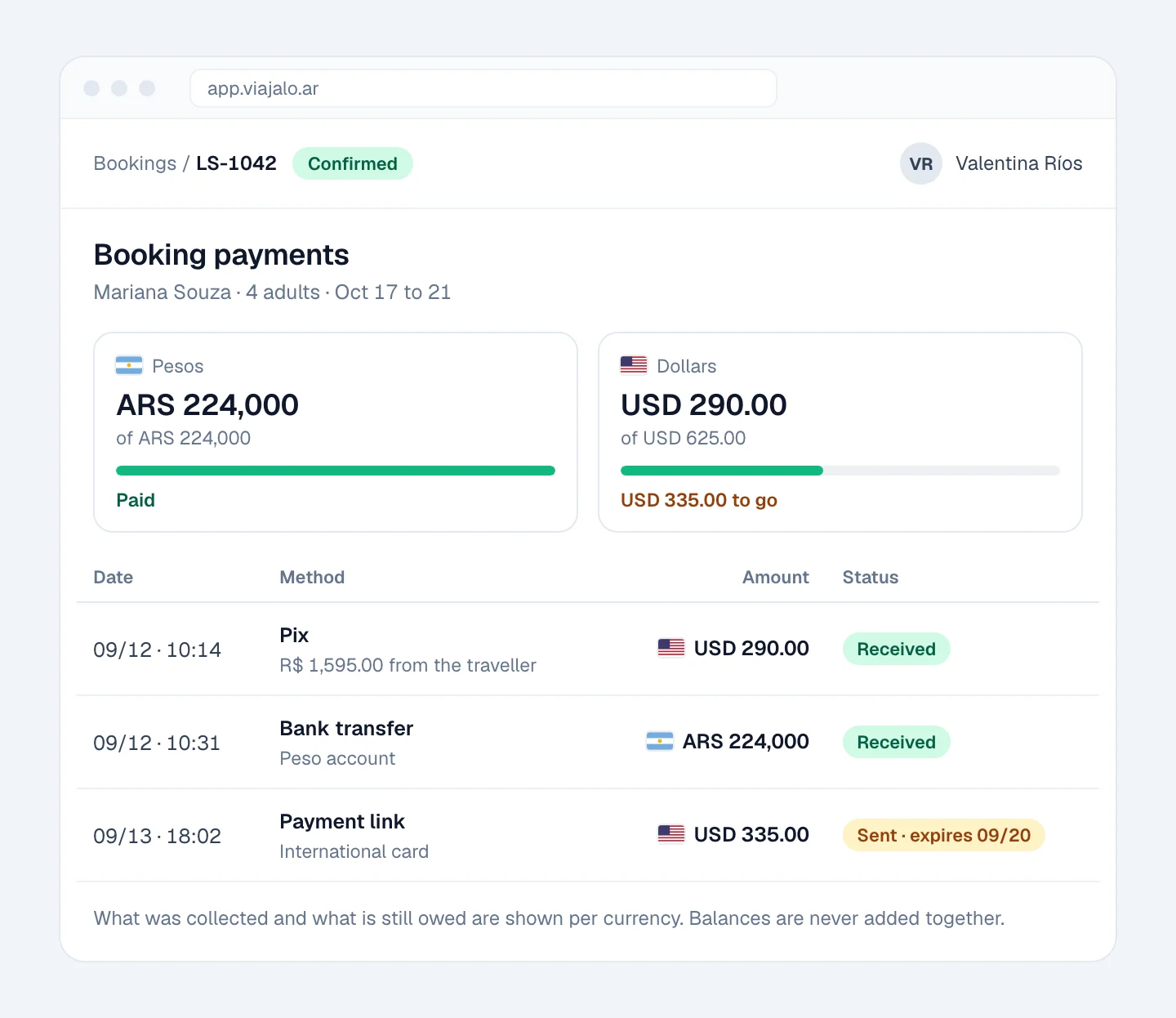
On the agency's side, each booking shows what has been collected and what is still owed per currency, without adding them together or keeping them in a separate spreadsheet. If the tour was paid in pesos and the transfer is still pending in dollars, both show up separately, and the dollar balance goes out as a payment link with its own expiry.
What no system decides for you is which currency to sell each tour in. That depends on how each supplier charges you, and it is still the agency's call.