# What is inbound tourism? How an inbound agency works
> What inbound tourism is, how it differs from outbound, real examples from Argentina and how an inbound agency or DMC runs day to day.
- URL: https://www.viajalo.ar/en/blog/what-is-inbound-tourism
- Published: 2026-10-19
- Language of this view: en
- Author: Facundo
- Other versions: es: https://www.viajalo.ar/blog/que-es-el-turismo-receptivo
Inbound tourism serves the visitor who arrives at a destination: a local agency sells and runs what they do while they are there. The Bariloche agency that takes a family from São Paulo to Isla Victoria is doing inbound; the São Paulo agency that sold them the trip did outbound.
## What inbound tourism is
Inbound tourism is the side of tourism that receives. A visitor arrives at a destination, from another region or another country, and an agency based there sells and runs what they do during the stay: excursions, transfers, tickets, guides and sometimes the accommodation.
The trade puts it in one line: inbound means selling in your own city to someone who came from elsewhere.
Plenty of agencies do both inbound and outbound, and they are better off treating them as two businesses. Outbound resells what others produce: flights, hotels, a wholesaler's package. Inbound produces what it sells. It owns the 9:30 departure, the 19 seats in the van, the guide who speaks Portuguese and the deal with the boat company. If a tour runs with two passengers instead of ten, nobody but the agency absorbs the difference.
## Inbound, outbound and domestic
The three words show up together in every tourism course, yet they do not measure the same thing. Two of them, inbound and outbound, describe what the agency does; the third is about who travels.
| | Inbound | Outbound | Domestic |
|---|---|---|---|
| Who travels | Arrives at the agency's destination | Leaves the place where the agency is | Residents travelling inside their country |
| What the agency sells | What happens at its destination: tours, transfers, tickets | Flights, hotels and packages somewhere else | Either of the two, depending on the case |
| Who owns the product | The agency or local suppliers | Airlines, hotels and wholesalers | Depending on the case |
| Who it sells to | The traveller and other agencies | The traveller | Depending on the case |
| The everyday problem | Capacity, suppliers, schedules and payments in several currencies | Fares, air availability and documents | Depending on the case |
The same trip lands in all three columns depending on where you stand. A family from Córdoba flying to Ushuaia is domestic tourism; for the Córdoba agency that sold the package it is outbound, and for the Ushuaia agency that puts them on the Beagle Channel boat it is inbound.
## What an inbound agency or DMC does
An inbound agency designs, sells and runs the services of a destination. DMC, short for destination management company, is the name used in English and in the corporate market for the same job, with more weight on groups and on selling to other agencies.
### Tours, transfers, accommodation and packages
The core of the business is the scheduled tour: a day and a time, a meeting point, a capacity that does not stretch. Around it sit airport transfers, shared or private, park tickets, accommodation when there is an agreement, and packages that span several days.
Each product is charged its own way. The tour, per passenger. A private transfer, per vehicle. Accommodation, per night. Many departures need a minimum number of passengers to run, and below it they are either merged with another one or run at a loss.
### Selling to travellers and selling to other agencies
An inbound agency sells through two channels at once. The direct one is the traveller who writes on WhatsApp or books on the website, and who pays on the spot or leaves a deposit.
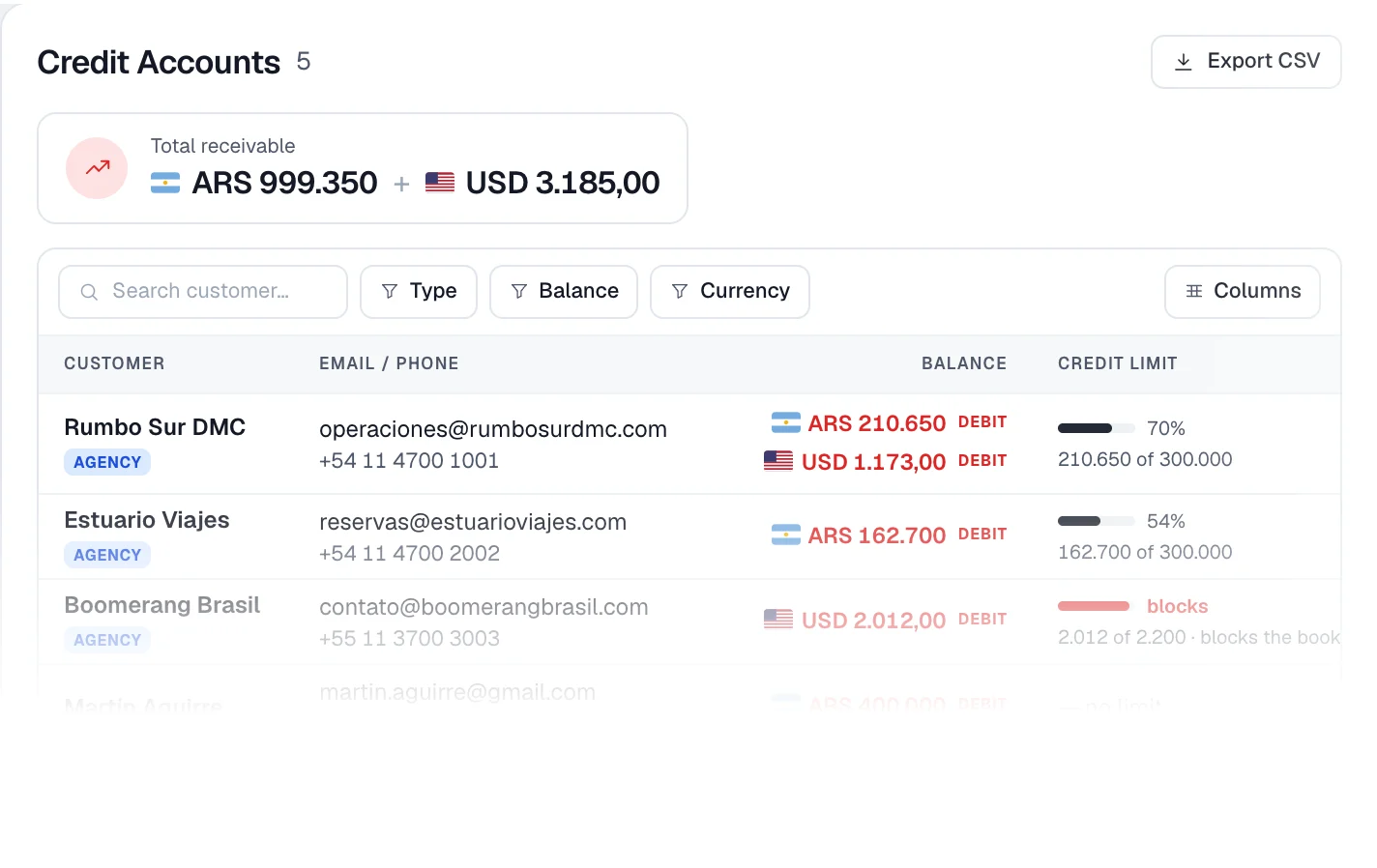
The other channel is what really sets inbound apart: it sells to other agencies. An outbound agency in Buenos Aires or São Paulo books seats for its clients at an agreed net rate and pays at the end of the month. The inbound agency becomes a supplier to agencies, and keeps a [current account](https://www.viajalo.ar/en/features/b2b-network) with each one, with its own credit limit.
What each buying agency owes, per currency, with its credit limit. Fictional agency, sample data.
## Examples of inbound tourism in Argentina
Bariloche is the textbook case. In summer, the boat to Isla Victoria and the Arrayanes forest, the Circuito Chico drive and the hikes; in winter, transfers to Cerro Catedral and ski lessons. A good part of the snow season is sold to Brazilian agencies that send groups with everything paid in advance.
Ushuaia works with a short window and two audiences: travellers who fly in for several days and cruise passengers with a few hours ashore. The Beagle Channel boat and Tierra del Fuego National Park have to fit into those hours, and each departure fills up fast.
In Iguazú inbound crosses a border. The falls are visited from the Argentine and the Brazilian side, with transfers through customs and travellers paying in pesos, reais or dollars, often within the same booking.
Buenos Aires runs differently: short stays, a lot of same-day buying and urban products such as the city tour, tango, Tigre or a day at an estancia. Mendoza lives on wineries and the high Andes, with tours that depend on whether the pass to Chile is open.
## What a day at an inbound agency looks like
An inbound operation revolves around one question: how many seats are left on each departure. Several channels touch that number at once, and when it is not kept in one place you get overbooking, which in high season is close to certain. The piece on [capacity per departure](https://www.viajalo.ar/en/blog/capacity-per-departure-without-spreadsheets) explains how it happens and how to avoid it.
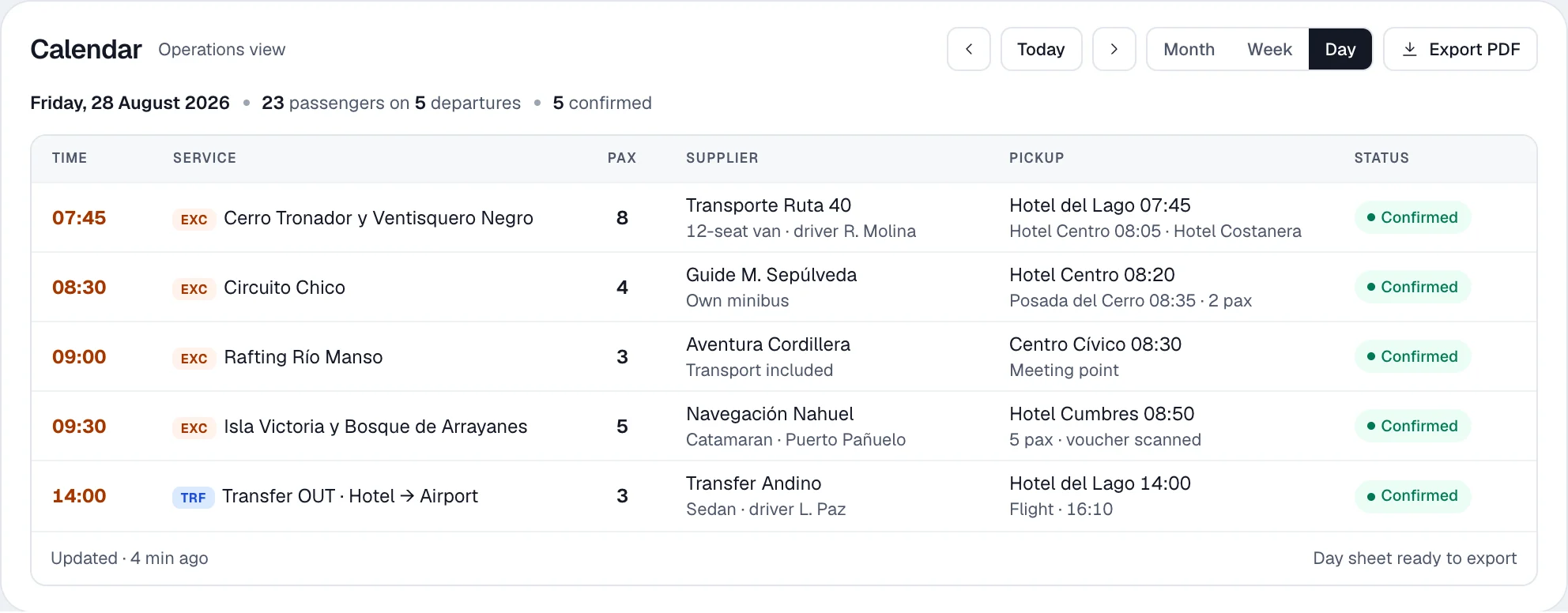
Then come the suppliers: the van owner, the guide, the boat company. Each one needs to know the time, the number of passengers and which hotels to pick them up from. The usual way is a message the night before, typed by hand.
One day on the schedule: each departure with its time, passengers, supplier and pickups. Fictional agency, sample data.
Payments are the third leg. On the same day pesos come in by bank transfer, dollars by international card, reais by Pix and deposits in cash, and at the end of the month the agencies that bought on credit settle up. The guide on [how to take payments from foreign travellers](https://www.viajalo.ar/en/blog/payment-methods-for-foreign-tourists) goes through the 8 methods in use and what each one costs.
All of it happens with a phone in hand. WhatsApp is where most enquiries arrive, where bookings get confirmed and where the traveller hears that the departure has moved.
## The tools an inbound agency uses
Almost every agency starts with a shared spreadsheet and the agency's WhatsApp, and that is fine: with few products and few people selling, it holds. It stops holding when two people sell the last seat on the same departure, or when nobody knows what an agency owes at the moment of taking its next booking. The comparison between [Viajalo, the spreadsheet and WhatsApp](https://www.viajalo.ar/en/comparisons/viajalo-vs-spreadsheets-and-whatsapp) shows where each one breaks.
Software for inbound work has to keep each departure's capacity live, sell to travellers and agencies at different prices, charge in each product's currency and build the day sheet for suppliers. The questions for choosing one are in [how to choose a system for an inbound agency](https://www.viajalo.ar/en/blog/how-to-choose-a-system-for-a-receptive-agency), and how Viajalo handles it is on the [booking and capacity system](https://www.viajalo.ar/en/features/bookings-and-capacity) page. For a DMC selling through other agencies, the whole picture is on the DMC software page.
## Frequently asked questions
### What is a DMC?
DMC stands for destination management company: a business that knows a destination and designs, sells and runs what happens there. In practice it is an inbound agency with more weight on groups, events and selling to other agencies. In Argentina the two terms are used almost interchangeably.
### Is inbound tourism the same as incoming?
Yes. Incoming is the word the wholesale trade uses for tourism arriving at a destination. An incoming agency and an inbound agency do the same job: they receive the visitor and run the local services.
### What does an inbound agency need to operate in Argentina?
The national law that regulated travel agencies, Law 18,829, was repealed by Decree 70/2023, and the national register became voluntary. Each province can require its own registration, so the first step is the tourism office of the province you will work in. On top of that: tax registration with ARCA, the municipal permits for a public-facing office, and agreements with the suppliers you will sell.
### Can an inbound agency sell to other agencies?
It is one of its largest sources of sales. An outbound agency from another city or country books seats for its clients at an agreed net rate and pays later, usually at the end of the month. That is why almost every inbound agency keeps a current account with each agency that buys from it.
### How is inbound tourism different from domestic tourism?
Domestic tourism describes who travels: residents moving within their own country. Inbound describes what the agency does: receiving whoever arrives. A traveller from Córdoba going to Ushuaia is domestic tourism for the country and inbound for the Ushuaia agency that runs their boat trip.